
Monkey Wrench – Word Search
Blue Ox Family Games, Inc.Word
4.71.60K Reviews
- Version
- Varies With Device
- Installs
- 100.00K
- Age Rating
- Everyone
Screenshots
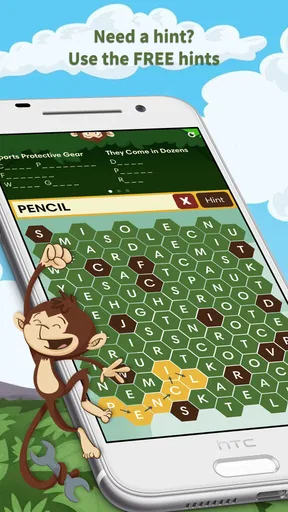
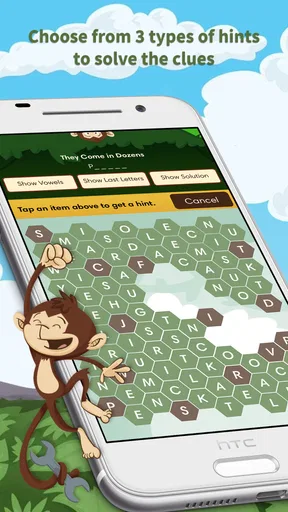
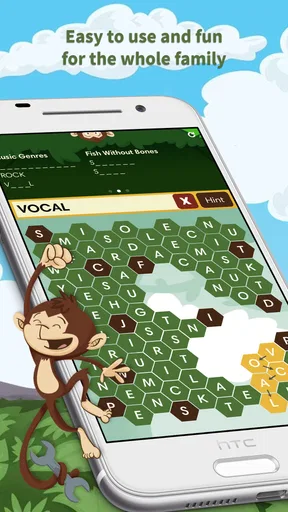
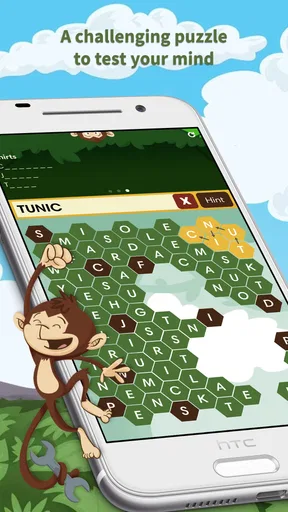
Our Review of Monkey Wrench – Word Search
 Analysis by Appyee
I picked up Monkey Wrench expecting a simple word-search distraction, and that is exactly where its appeal lies. It does not ask me to learn complicated rules or manage a long list of systems before I can start. I look for hidden words, work through the puzzle in front of me, and decide whether I want another round. For a family-friendly word game, that directness is a real strength.
At the same time, a small word-search game succeeds or fails on details that are easy to overlook: how quickly a puzzle becomes readable, whether the challenge feels fair, and whether finishing one board gives me a reason to continue. My experience with this game is positive when I want a calm mental break, a shared activity with younger players, or a lightweight way to exercise visual attention. It is less convincing for anyone looking for a deep campaign, competitive ranking, or a constantly changing puzzle system.
How the first few puzzles establish the goal
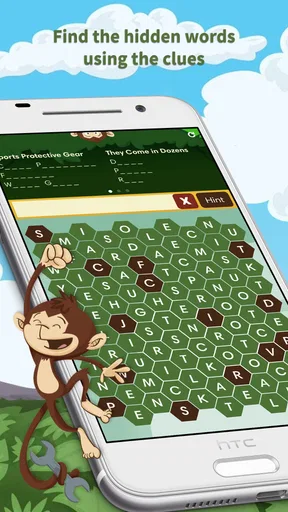
The basic objective is immediately understandable: scan the letter grid and find the hidden words. That makes the opening moments unusually welcoming. I do not need a tutorial-heavy introduction, and I can hand the phone to someone else without explaining a complicated control scheme. The game’s central idea is visible from the first puzzle, which suits its Everyone age rating and its family-oriented design.
That simplicity also creates the first important decision. I can rush through the grid by looking for obvious letter patterns, or I can slow down and search methodically. The latter approach is more reliable, especially when the remaining word is hidden among similar-looking letter combinations. I found that the game rewards patience more than frantic tapping, so it works well when I want something relaxing rather than stressful.
In an everyday situation, I could see myself opening it while waiting for an appointment or during a quiet break at home. It is also a reasonable choice for a parent and child to play side by side: one person can call out possible starting letters while the other traces the grid. Because the rules are so easy to explain, the game does not create the usual barrier where one player understands the interface and the other simply watches.
The early goal is therefore clear, but not especially layered. I am solving the current word search rather than building a character, collecting equipment, or shaping a long-term strategy. That focus is useful for short sessions, although players who need a strong narrative reason to continue may find the opening too modest.
What progress feels like during a session
Progress in a word search is naturally measured by visible completion. Each word I locate reduces the unfinished portion of the board, and that shrinking list gives the puzzle a simple rhythm: identify, confirm, scan again. I like that the progress signal is understandable without extra explanation. Even when I am stuck, I know exactly what remains to be found.
One practical technique is to avoid searching for the longest or most unusual word first. I usually begin with words that have distinctive letter combinations, then use the cleared entries to narrow my attention. If several words share a common beginning, I check likely directions rather than repeatedly scanning the whole board. This makes the game feel less like random guessing and more like a small visual investigation.
Another useful habit is to change my scanning pattern when I stall. Instead of reading every row from left to right, I look vertically, diagonally, and from the opposite direction. That sounds obvious, but fatigue makes players repeat the same search path without noticing. A short pause followed by a different scanning direction often helps more than tapping around impatiently.
The game’s audience response suggests that this straightforward loop has found a comfortable audience. It holds an average rating of 4.7 from around 5K ratings, with about 1.6K written reviews, and it has passed 100K installs. Those figures do not turn a simple puzzle into a complex one, but they do indicate that the uncomplicated format is working for many people.
I would not describe the progress as expansive. The satisfaction comes from solving the board in front of me, not from watching a large map open up or unlocking a collection of elaborate abilities. That distinction matters when deciding whether to install it. If I want a dependable sequence of small goals, it fits. If I want progress that changes the way I play, I would look toward a more feature-heavy puzzle game.
How the difficulty curve affects the pace
The best word-search games create a gentle tension: the board should be approachable at first, but not so obvious that I can finish without looking carefully. Monkey Wrench works best when I treat each puzzle as a focused observation task. The challenge comes from locating words inside a field of distracting letters, so the difficulty is tied to attention and persistence rather than complicated rules.
That makes the pacing naturally uneven from one player to another. Someone with strong visual scanning skills may move quickly, while a younger player or a tired adult may need much longer on the same kind of board. I appreciate that flexibility because it lets the game serve different ages without demanding a separate mode of play. The trade-off is that a player who becomes very efficient may feel the basic loop is familiar sooner than expected.
When I play casually, I prefer not to treat speed as the only measure of success. I scan in sections, keep track of likely directions, and resist the temptation to restart mentally after missing a word. This approach makes the game feel calmer and reduces the frustration caused by staring at the entire grid at once. For children, it can also turn the puzzle into a lesson in concentration without making the activity feel like homework.
The difficulty is most enjoyable when I am alert but not rushed. On a crowded commute or in a noisy room, the same puzzle can feel more irritating because my attention keeps breaking. That is not a flaw unique to this game; it is a consequence of the format. Still, anyone who wants a puzzle that tolerates constant interruption may prefer a turn-based game with more forgiving pause points.
Compared with a daily word puzzle, this game offers less emphasis on a single shared challenge or a carefully anticipated answer. Compared with a crossword, it asks less of my vocabulary and more of my visual search skills. Compared with a word game built around anagrams or spelling construction, it is more accessible because I am recognizing words rather than generating them from scratch. Those differences make it a good choice for mixed-age play, but they also explain why serious word-game fans may eventually want more variety.
What encourages another round, and where that pressure stops
The strongest reason to continue is the short feedback loop. Finding one word makes me curious about the next, and a nearly completed grid creates a natural urge to finish rather than leave a single answer unresolved. I often find that the last few words receive more attention than the first ones because the remaining possibilities are easier to isolate.
That is a gentle form of retention rather than an aggressive one. The game invites another puzzle through completion momentum, not through a story cliffhanger or a complicated reward schedule. I prefer that approach for a casual title because it does not make a quiet activity feel demanding. I can stop after a puzzle without feeling that I have abandoned a large obligation.
There is also a useful social angle. A family can pass the device around, compare search techniques, or let a child take the lead while an adult helps with difficult sections. The game’s free price makes that kind of low-commitment trial easier, while optional in-app purchases ranging from $0.99 to $9.99 per item may matter to people who want to spend beyond the basic download. I would approach those purchases deliberately rather than assuming they are necessary for everyone.
The limitation is that the motivation remains closely tied to the same activity. If I have already solved several boards in one sitting, I may want a change of pace rather than another grid. Players who are motivated by rankings, character upgrades, timed events, or a strong sense of collection will probably find the retention loop too light. For me, that is acceptable because the game is at its best as a compact break, not as the main game on my phone.
One way to keep the experience from becoming repetitive is to give each session a clear boundary. I might play while drinking coffee, finish one puzzle, and close the app instead of continuing automatically. Another option is to use it as a shared activity and alternate who searches first. These small habits preserve the relaxed quality and prevent the simple loop from turning into visual fatigue.
Who should choose it over familiar alternatives
I would recommend this game to someone who wants a word-search experience that can be understood in seconds. It is particularly suitable for families, casual players, and people who prefer recognition-based puzzles over spelling challenges. The Everyone rating reinforces that broad accessibility, and the free entry point makes it easy to test without treating the download as a major commitment.
I would also suggest it to players who dislike games that constantly interrupt a puzzle with menus, equipment choices, or elaborate progression screens. Here, the appeal is the board itself. The developer, Blue Ox Family Games, Inc., has kept the central activity easy to identify, which helps the game feel approachable even for someone who does not regularly play mobile games.
On the other hand, I would skip it if my priority were competitive pressure or a substantial long-term campaign. A crossword app may be better if I want clues and vocabulary depth. An anagram game may suit me more if I enjoy constructing answers from limited letters. A daily puzzle app may be preferable if I want a fixed routine and a shared conversation around one challenge. Monkey Wrench is not trying to replace all of those formats; it occupies the quieter space between them.
Parents may reasonably wonder whether a child can use it without constant instruction. The rules are simple enough for independent play once the child understands that words are hidden in different directions, although younger players may still benefit from an adult showing how to scan systematically. Adults may also ask whether it is useful for short breaks. In my view, yes, provided the goal is light concentration rather than a demanding brain-training program.
The game first appeared on February 17, 2016, and its age is worth considering in context. It does not need to chase every current mobile trend to deliver a functional word-search session, but players expecting modern presentation conventions or a large ecosystem of connected features may notice that it feels deliberately traditional. That is not automatically negative; it simply sets the right expectation before installing.
My verdict on goals, progression, and staying power
Monkey Wrench succeeds because its early goal is obvious, its progress is visible, and its challenge is easy to understand. I always know what I am trying to do, what remains unfinished, and why one more search might be satisfying. For a free word game, that clarity is more valuable than a long list of systems that would distract from the puzzle.
Its progression is modest rather than transformative. I do not play to unlock a new style of strategy; I play because finding hidden words is pleasant and occasionally absorbing. That makes the experience well suited to short sessions, family use, and relaxed attention. It also means the game has a natural ceiling for players who need novelty, competition, or a richer sense of achievement.
My main advice is to approach it with the right expectation: this is a focused word-search game, not a full progression-driven adventure. Use a deliberate scanning pattern, switch directions when stuck, and stop before the visual repetition becomes tiring. Those habits make the straightforward design feel more rewarding and help the game fit neatly into everyday downtime.
After playing it, I would recommend it to a friend who wants an uncomplicated puzzle that can be shared with the whole family. I would not recommend it as the only word game for someone who quickly exhausts familiar formats. Its strengths are accessibility, a clear goal, and a calm pace; its weakness is that those same qualities limit variety. For the right player, that balance is exactly the point, and the free download makes it easy to find out whether this simple search-and-solve loop suits you.
Verdict
Strengths of Monkey Wrench – Word Search
- Relaxing word-search gameplay suitable for short sessions.
- Simple controls make it easy for beginners to start playing.
- Multiple puzzles provide a steady stream of challenges.
- Helpful hints can assist when a word is difficult to find.
- Good fit for players who enjoy vocabulary and observation games.
Limitations of Monkey Wrench – Word Search
- Some puzzles may feel repetitive after extended play.
- Difficulty progression may not satisfy experienced word-game fans.
- Small screens can make diagonal words harder to select accurately.
- Hint availability may reduce the challenge for some players.
- Offline features and supported languages may be limited.
Other Releases by Blue Ox Family Games, Inc.
View All
7 Little Words and More
Word4.7
Similar Picks in This Category
View All
Word Search - Word Puzzle Game
Bluetile4.8

Word Search Quest - Puzzles
Blackout Lab4.8

CodyCross: Crossword Puzzles
Fanatee, Inc.4.7

Words of Wonders: Crossword
Fugo Games4.9

Wordscapes: Word puzzle game
PeopleFun4.7

Word Search Explorer
PlaySimple Games4.9
Frequently Asked Questions
What is Monkey Wrench – Word Search?
Monkey Wrench – Word Search is a word puzzle game centered on finding hidden words in letter grids. It is designed for players who enjoy casual brain-training challenges, with a playful theme and straightforward controls. Each puzzle asks you to scan the board, identify the requested words, and complete the level, making it suitable for short sessions or longer relaxing play.
How do you play Monkey Wrench – Word Search?
Gameplay is based on locating words hidden horizontally, vertically, or diagonally within a grid of letters. You normally select a word by dragging across its letters, and correctly identified words are marked on the board. The difficulty can vary between puzzles, so careful scanning is important. Players who get stuck may need to use available hints or revisit overlooked letter combinations.
Is Monkey Wrench – Word Search free to download and play?
The game may be available as a free download, but the exact business model can depend on the version and platform. Free puzzle games commonly include advertising, optional in-app purchases, or paid features such as extra hints and ad removal. Before downloading, check the Google Play Store or Apple App Store listing for current pricing, subscriptions, advertisements, and purchase requirements.
Does Monkey Wrench – Word Search work offline?
Many word-search puzzles can often be played without a continuous internet connection once the necessary game content has been installed. However, features such as advertisements, online rewards, updates, cloud synchronization, or purchases may require internet access. Because offline availability can differ by version, it is best to test the game in airplane mode after installation and review the developer’s store description.
Is Monkey Wrench – Word Search suitable for children?
The simple word-search format can be appropriate for children who can read and recognize words, while also offering a relaxed way to practice spelling and visual concentration. Parents should still check the listed age rating, advertising policy, and in-app purchase settings before allowing unsupervised play. If the game includes external links, ads, or optional purchases, parental controls are recommended.
Play our best games!


